"Calling Me a Narcissist... and Then Asking to Be My Friend?"
A Psychological Exploration of Danny West’s Contradictions and the True Nature of Friendship.
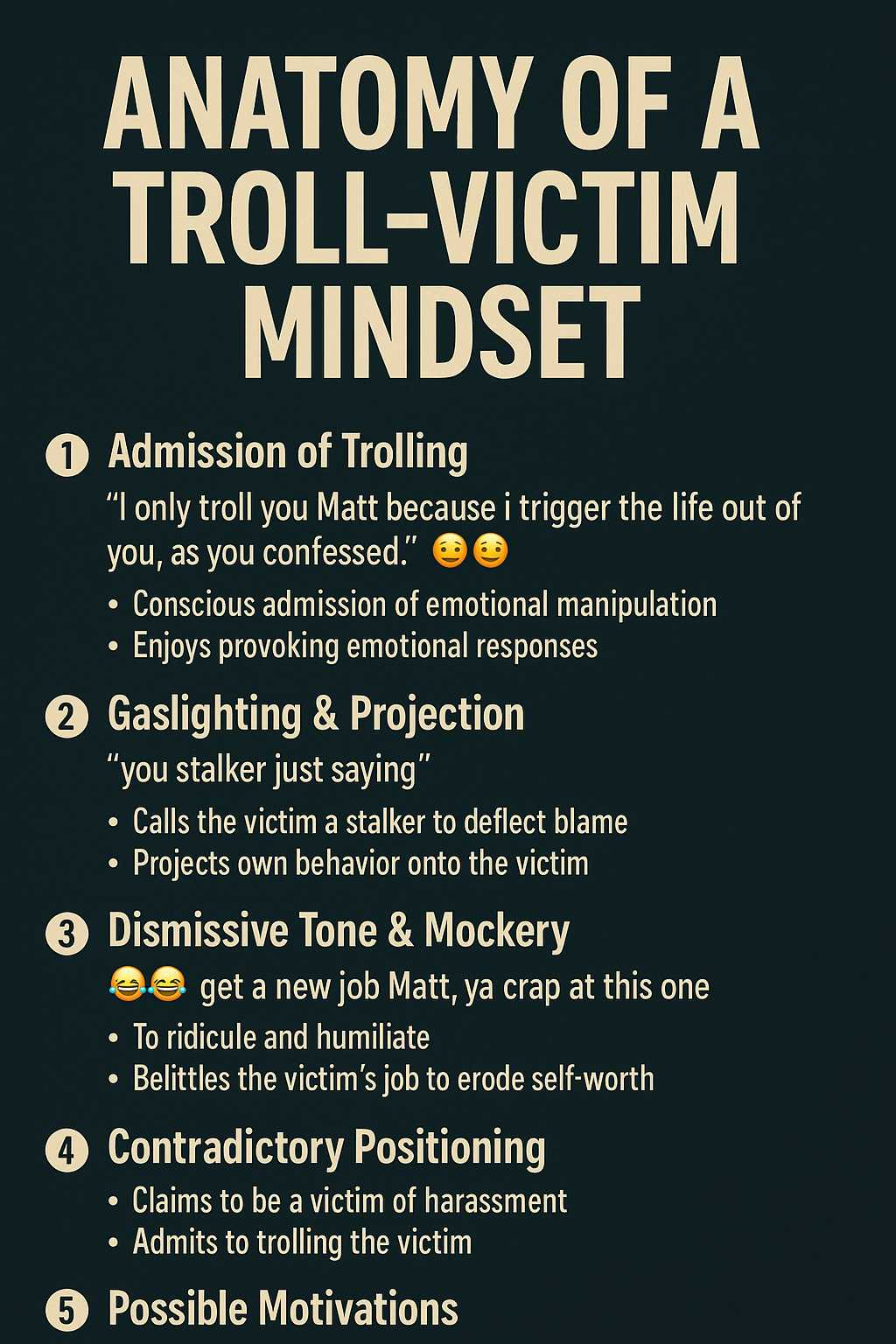
In the tangled undergrowth of online conflict, one often encounters the peculiar dance of insult followed by invitation. In a recent exchange, Danny West calls me, Matt Taylor, a "narcissist," a "nonce," a "stalker," a "predator," and a "Walter Mitty." And yet, in the same breath, he extends an offer of friendship. This, on its face, is absurd. But dig a little deeper, and it becomes a fascinating case study in projection, gaslighting, and the abuse dynamics of pseudo-relationships—especially in the online arena.
Accusation Followed by Affection: A Classic Abuser’s Move.
The logic is baffling. If someone genuinely believed you were a narcissist, stalker, and predator—why on Earth would they want to be your friend?
Unless, of course, the accusations weren’t genuine in the first place.
This tactic is common in psychological manipulation:
First, vilify.
Then, extend a hand.
It’s an emotional yo-yo designed to control, destabilise, and confuse the target. One moment you're being demonised, the next you're offered reconciliation. This is not maturity—it's manipulation dressed in spiritual garb.
Danny says:
“We could become friends now.”
Let’s be very clear: No healthy person wants to be friends with someone they truly believe is dangerous or deceptive. The desire for friendship suggests that deep down, Danny does not believe the insults he throws—or, he uses them as weapons, not truths.
Who’s the Narcissist, Really?
Danny calls Matt a narcissist. But let’s analyse the following traits:
Calling someone names repeatedly while claiming to be the victim
Demanding emotional closure from someone they’ve abused.
Offering conditional friendship based on their terms of "maturity and sincerity."
Acting as if they are the arbiter of who you are and what mental illness you have.
Rewriting history to suit a personal narrative of redemption and peace.
These are textbook examples of narcissistic behaviour—not on Matt’s part, but on Danny’s.
Narcissists often:
Project their traits onto others (e.g., “you’re the narcissist!”)
Refuse to acknowledge harm done
Pretend to be the bigger person while never taking true accountability
Demand access to people they've previously hurt to validate their self-image as "good guys"
So when Danny says:
“Hopefully Matt is now on that road… good luck Matt… we could become friends now,”
what he’s really doing is recasting himself as the wise, mature man offering forgiveness to a man he’s abused, all while pretending the abuse never happened.
This is delusional, condescending, and yes—narcissistic.
Boundaries Are Not Narcissism. They Are Self-Respect.
You say:
“I don’t want to be his friend, and find it particular that he thinks someone he calls a nonce, stalker, predator and a walter mitty, will want to be his friend.”
That’s a healthy response. It’s not vindictive. It’s not even unkind. It’s reasonable.
No one is obliged to become friends with someone who publicly ridiculed, defamed, or diminished their life’s experiences.
Friendship is based on trust, respect, and mutual understanding—not gaslighting, accusations, or public humiliation.
To suggest otherwise is to fundamentally misunderstand the nature of human connection—or worse, to weaponise friendship as a tool of control.
“Admitting He Is a Narcissist Is the First Step…”
Let’s be crystal clear:
Matt Taylor has never admitted to being a narcissist.
Danny West simply interprets statements to suit his narrative and presents them as facts.
This is not maturity.
This is narrative hijacking—a narcissistic impulse to dictate someone else’s identity and journey.
It’s like setting someone’s house on fire and then applauding yourself for handing them a glass of water.
Conclusion: “I Don’t Want Anything to Do With Him.”
That is your boundary, Matt. And it’s not just reasonable—it’s essential.
You don’t owe friendship, forgiveness, or future access to someone who made a sport of mocking your life, your name, and your livelihood.
Danny’s version of reconciliation is self-serving. It allows him to feel like the good guy, without ever having to truly say:
"I’m sorry."
"I was wrong."
"You didn’t deserve that."
Until that day comes—and it likely never will—the only sane response is yours:
“I don’t want anything to do with him.”
And that’s not narcissism.
That’s called integrity.