


A court case is a private matter between the people involved in it and the justice system. A hearing takes place, arrangements are made, and eventually the parties are informed of what happens next.
So imagine my surprise when a particular date connected with my court case appeared to be known and displayed by someone who isn't a defendant, isn't the complainant, isn't a witness and, as far as I am aware, has no involvement in the proceedings whatsoever.
That person is Alex Jones of Colchester, associated with Castle Corbenic Ltd. Public company information identifies Alex Jones as a person with significant control of Castle Corbenic Ltd, with 75% or more of the shares and voting rights.
And that brings us to the rather obvious question:
What exactly has Alex Jones got to do with my court case?
Apparently, nothing.
Yet somehow the date has become something worthy of being displayed publicly.
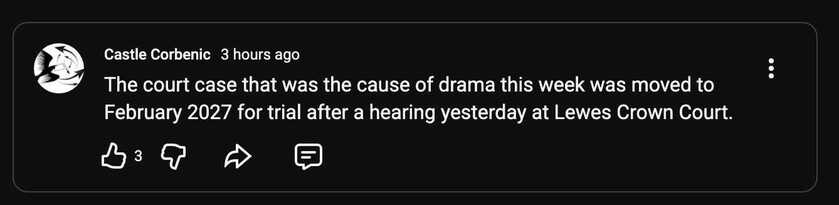
“The court case that was the cause of drama this week was moved to February 2027 for trial after a hearing yesterday at Lewes Crown Court.”
Fair enough.
Except there is an interesting little detail in all of this.
It wasn't Alex Jones's court case.
It wasn't his hearing.
It wasn't his trial.
It wasn't his prosecution.
It wasn't his defence.
And he wasn't the person sitting in court waiting to discover when the next stage of the proceedings would take place.
So why does he feel entitled to put the date out there?
There's a difference between knowing something and being entitled to announce it
This is where things get interesting.
There is nothing inherently mysterious about a court listing. Court cases can, in appropriate circumstances, become publicly accessible information. The fact that somebody knows about a hearing does not automatically mean that they have committed an offence by mentioning it.
But there is a significant distinction between "I know something" and "I have a reason to announce something."
Those are two completely different questions.
And in this particular situation, the question I am asking isn't:
“Is Alex Jones legally allowed to know the date?”
The question is:
“Why is Alex Jones interested in publicising the date of somebody else's criminal trial, particularly when the people directly involved had apparently not yet been informed?”
That is a very different question.
The curious timing
According to the statement above, the case was moved to February 2027 following a hearing at Lewes Crown Court.
But if the defendant and complainant hadn't yet been told the new trial date, then seeing somebody else publicly displaying that date creates an obvious question:
How did they know?
And perhaps even more importantly:
Why were they displaying it?
I'm not suggesting an answer.
I'm not claiming Alex Jones obtained confidential information.
I'm not alleging that he interfered with the court.
I'm not suggesting that he has done anything unlawful.
Those are matters that would require evidence.
I'm simply pointing out the oddity of the situation.
A court case concerning me has a new date.
Alex Jones isn't involved.
And yet Alex Jones appears sufficiently interested in that date to put it on display.
That's the bit I find fascinating.
The obsession with somebody else's calendar
There is also something rather surreal about watching people on the outside become fascinated with the calendar of a court case in which they have no formal role.
Imagine having your own life, your own work, your own company and your own problems to deal with—and nevertheless finding the time to keep track of when somebody else's trial has been listed.
Then imagine announcing the date before the people actually involved have apparently been told.
At that point, the natural reaction isn't necessarily outrage.
Sometimes it is simply:
“Why?”
Why is this important to you?
Why are you monitoring it?
Why do you feel the need to tell everyone else?
And what exactly is the purpose of doing so?
Those are perfectly reasonable questions.
And then there's Castle Corbenic
Alex Jones is publicly associated with Castle Corbenic Ltd. Companies House-derived information identifies him as the person with significant control of the company.
Castle Corbenic's own public-facing description of its activities is one thing.
But my court case is another.
There is no obvious connection between running a company and monitoring the date of my trial.
Which brings us back to the title of this piece.
What has the date of my court case got to do with Alex Jones?
On the information available to me:
Nothing.
And that is precisely why the public display of the date is interesting.
If Alex Jones were involved as a defendant, complainant, witness, lawyer, journalist or otherwise formally connected with the proceedings, there would be an obvious explanation.
But if he isn't involved, then the explanation becomes less obvious.
And when something isn't obvious, asking questions isn't unreasonable.
The important distinction
I want to be careful here.
There is a massive difference between saying:
“Alex Jones published the date of my trial.”
and saying:
“Alex Jones did something unlawful by publishing the date.”
The first is a factual proposition that can potentially be established by looking at what was published.
The second is a legal conclusion requiring considerably more information.
I'm making the first observation and asking questions about it.
I'm not pretending to know the answer to the second.
Perhaps there is a perfectly innocent explanation.
Perhaps the information was publicly available.
Perhaps someone else gave him the information.
Perhaps he simply came across it somewhere.
Perhaps he thought it was interesting.
Perhaps he considered it relevant to his audience.
There are numerous possibilities.
But if that's the case, why not simply say so?
The irony
The irony is that the court case is supposed to be about what happens in court.
Not what happens on YouTube.
Not what happens on Facebook.
Not what Alex Jones thinks.
Not what somebody else predicts.
And certainly not about people celebrating or anticipating a trial before the evidence has been tested and a court has reached its conclusions.
The proper place for the allegations against me is the courtroom.
The proper place for the evidence is the courtroom.
And the proper place for the verdict is the courtroom.
Until then, there is a defendant who is entitled to the presumption of innocence.
So perhaps the more interesting question isn't:
“When is Matt Taylor's trial?”
Perhaps it is:
“Why is Alex Jones so interested in knowing?”
And that, ladies and gentlemen, is a question I don't have an answer to.
But Alex Jones might.
Maybe he should tell us.